
Toyota Land Cruiser LX Rooftop Tent & Camping in Uganda
Uganda — the Pearl of Africa — rewards travelers who venture beyond the lodge. Roof tent camping aboard a Toyota Land Cruiser LX unlocks a freedom that no fixed accommodation can match: sleeping above the canopy at Queen Elizabeth, waking to mountain mist in Bwindi, and stargazing from Kidepo Valley without another tent in sight. This guide covers everything you need to know — from choosing the right LX configuration and rooftop tent, to packing lists, campsite-by-campsite breakdowns, and safety tips honed from years of overland experience in East Africa.
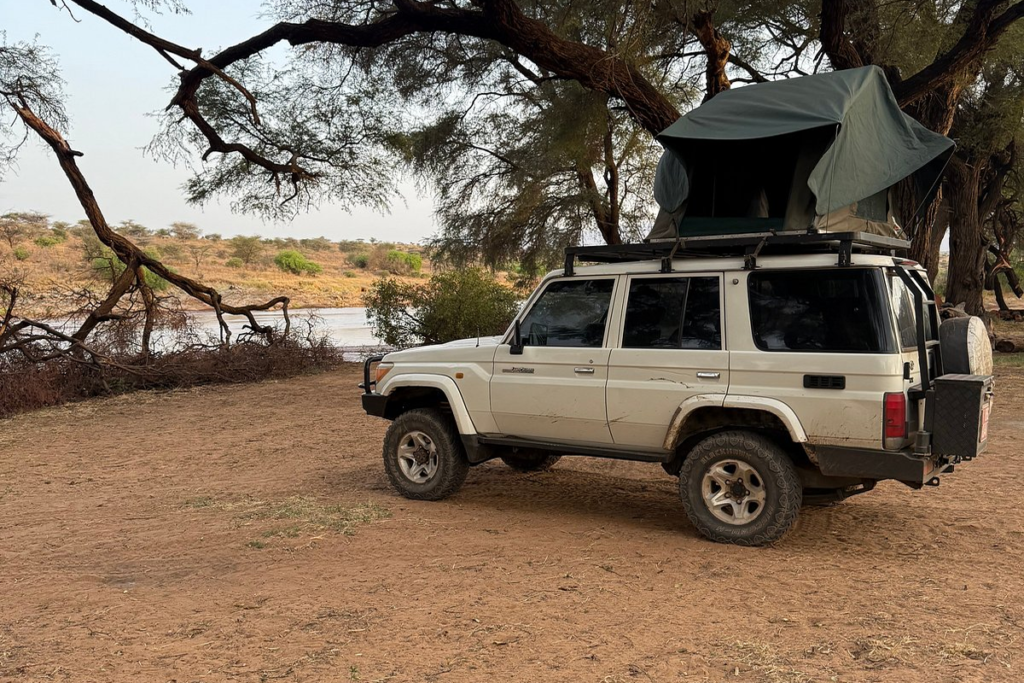
1. Why the Toyota Land Cruiser LX for Uganda Camping?
The Toyota Land Cruiser has dominated African safari roads for over five decades, and its LX (Luxury) variant adds refinements that make extended camping comfortable without sacrificing off-road ability. Here is why it is the benchmark choice for self-drive campers in Uganda.
1.1 Engine & Drivetrain
- Engine: 4.5-litre V8 twin-turbo diesel (LC200 platform) producing 195 kW and 650 Nm of torque
- 4WD System: Part-time 4WD with center diff-lock, low-range transfer case, and Kinetic Dynamic Suspension System (KDSS) on higher trims
- Ground Clearance: 225 mm — sufficient for rutted murram roads, flooded crossings, and rocky escarpments in Kidepo
- Approach/Departure: 32° approach angle and 23° departure angle handle Uganda’s notorious track lips
Uganda’s road network spans tarmac highways to deeply corrugated murram tracks. The Land Cruiser LX navigates both with the composed ride quality its suspension tuning is famous for.
1.2 Payload & Roof Load Rating
- Gross Vehicle Mass (GVM): approximately 3,350 kg on the LC200 platform
- Roof Rack Static Load: 150 kg (dynamic load rating 100 kg while moving)
- This comfortably handles a quality rooftop tent (35–55 kg), annexe room (8–12 kg), and gear bag (10–20 kg)
🏕 Tip: Always verify the roof load rating with your rental company before booking. Some older Land Cruiser LX models may have aftermarket racks with lower ratings.
1.3 Fuel Range & Tank
- Fuel Tank: 93-litre main + 87-litre sub tank on most LX specifications (180 litres total)
- Combined consumption: approximately 11–14 L/100 km on murram tracks
- Theoretical range: 1,200–1,600 km on a full tank
This range is critical in Uganda where fuel stations disappear entirely between Kampala and Kidepo Valley National Park. Carry a 20-litre jerry can as a minimum precaution.
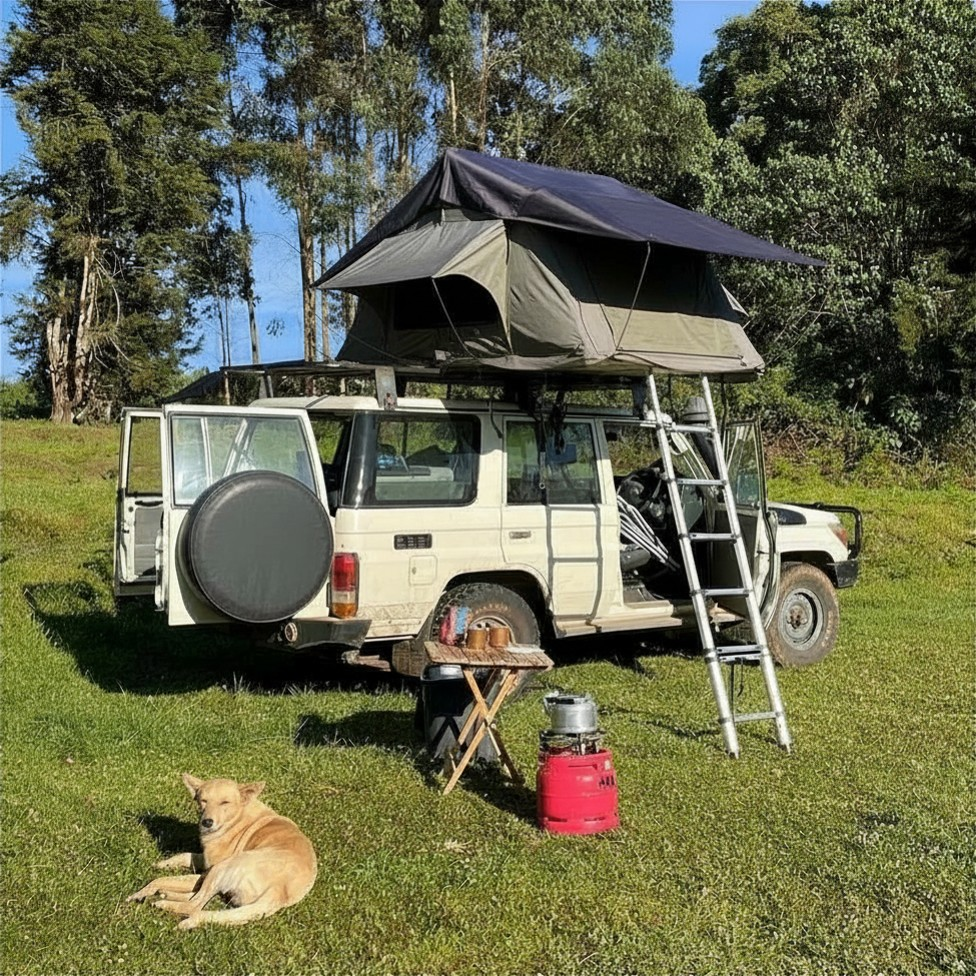
1.4 Interior Comfort for Multi-Day Camping
- Third-row seating folds flat to create a 2.0 m load space for gear when travelling as a couple
- Dual-zone climate control manages Uganda’s humidity on humid lowland drives
- 110 V/220 V inverter socket (on premium LX specs) powers a portable fridge and charges devices
- Rear diff-lock and crawl control for technical terrain in Bwindi and Mgahinga
2. Rooftop Tents: Types, Features & Recommendations
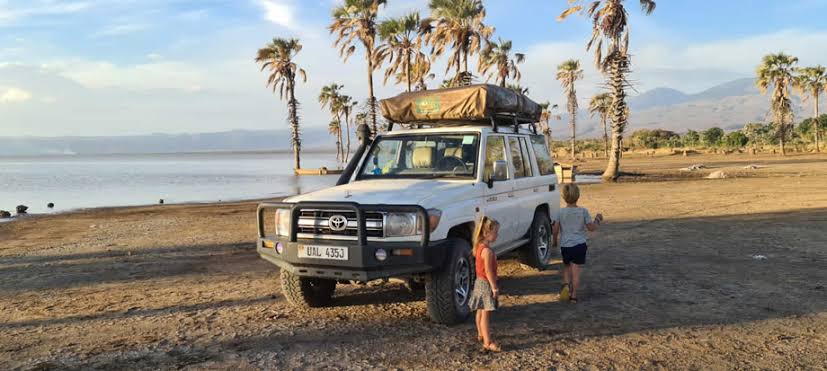
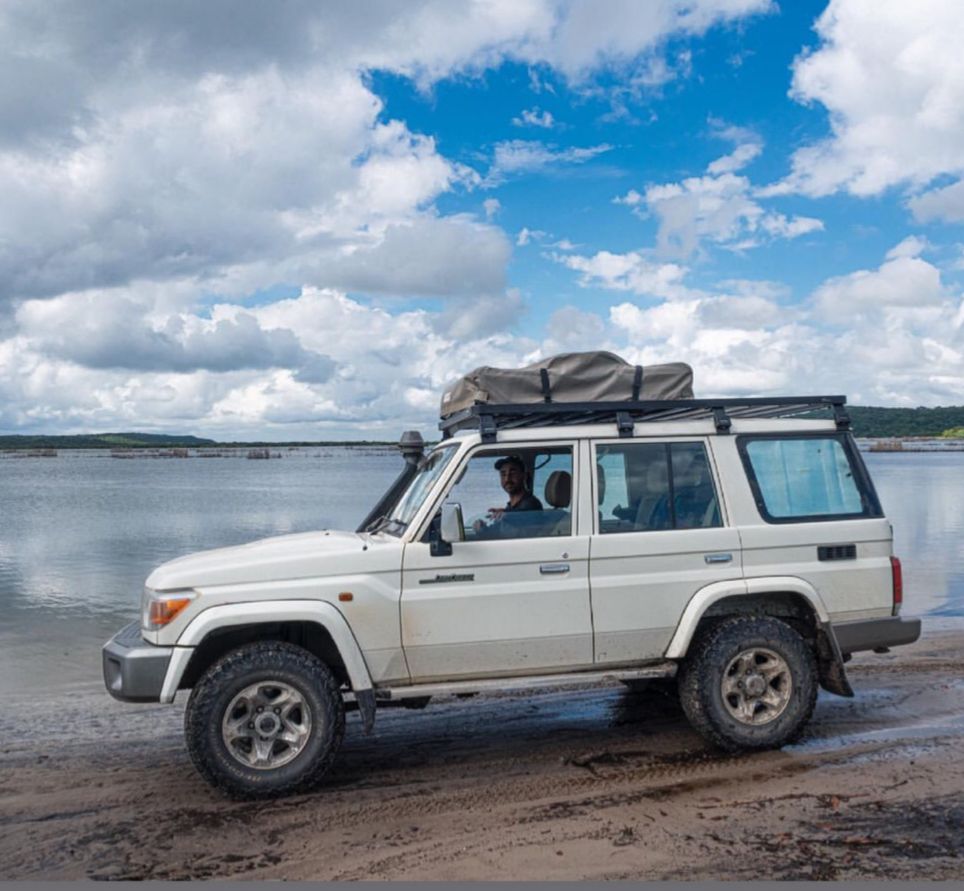
A rooftop tent (RTT) transforms the Land Cruiser LX from transport to campsite. Mounted on a fixed aluminum roof rack, it deploys in under two minutes and keeps you 1.5–1.8 metres above the ground — well clear of ground moisture, crawling insects, and most camp scavengers.
2.1 Soft-Shell vs Hard-Shell Rooftop Tents
Soft-Shell (Folding) RTTs
- How they work: A canvas tent folds flat on a hinged base, secured by straps. Unfold and the tent pops up, supported by internal poles.
- Weight: 35–50 kg — lighter and better for fuel economy
- Pack height: 25–35 cm — lower centre of gravity, less wind drag
- Setup time: 2–4 minutes
- Ventilation: Excellent — full-perimeter mesh panels suit Uganda’s humid lowland parks
- Recommended models: Alu-Cab Khaya, Front Runner Roof Tent, ARB Simpson III
- Price range (purchase): USD 800 – USD 2,500
Hard-Shell (Clam-Shell) RTTs
- How they work: A rigid fibreglass or aluminium shell opens in a single motion, mattress inside stays permanently made up
- Weight: 50–75 kg — heavier, slightly more roof-load consideration
- Pack height: 12–18 cm — more aerodynamic, reduced wind noise
- Setup time: Under 60 seconds
- Weatherproofing: Superior — ideal for Bwindi’s heavy rain and Kidepo’s dust storms
- Recommended models: Alu-Cab Falcon, iKamper Skycamp, James Baroud Evasion
- Price range (purchase): USD 2,800 – USD 5,000
🌧 Uganda Weather Note: Bwindi Impenetrable Forest receives over 1,400 mm of rainfall annually and experiences rain in most months. A hard-shell RTT or a soft-shell with a full rainfly is essential.
Key Features to Look for
- Mattress thickness: Minimum 50 mm high-density foam; 65–75 mm ideal for extended trips
- Annexe room compatibility: Allows a ground-level sleeping or living extension for guides or children
- Integrated ladder: Hinged aluminum ladder that doubles as a step when the tent is open
- Anti-condensation mat: Critical in Uganda’s highland parks where overnight temperatures drop to 8–12°C in Bwindi
- Stargazing window: Optional but spectacular at Kidepo under the Milky Way
- Storage pockets: Keep torches, passports, and insect repellent within reach overnight
Roof Rack Compatibility with the LX
The Land Cruiser LX runs on the LC200 body (2007–2021) or the newer LC300 platform (2022+). Both use a standard factory roof rail. Aftermarket racks from Alu-Cab, ARB, Rhino-Rack, and Front Runner all produce LC200/LC300-specific mounting kits. The rack must have a minimum of four mounting points and should ideally be a full-length platform rack to distribute tent weight evenly.
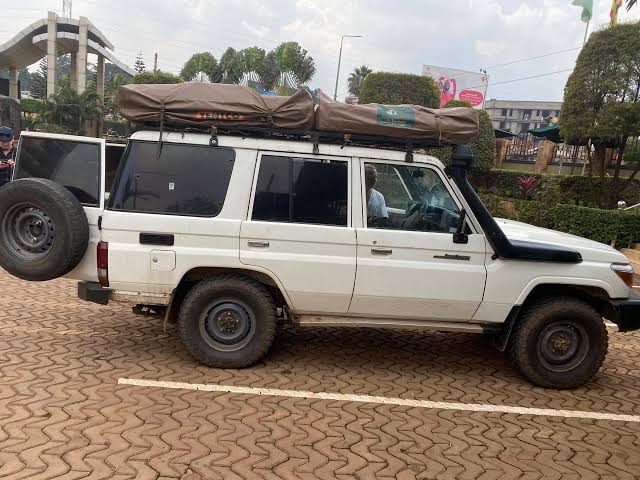
Rooftop Tent Camping Logistics in Uganda
Renting vs Bringing Your Own
Most travelers rent a pre-equipped Land Cruiser LX with rooftop tent from a Uganda-based safari rental company. This eliminates the cost and logistics of shipping camping equipment internationally.
What a Good Uganda Rental Package Includes
- Land Cruiser LX with full-length roof rack and mounted RTT
- Ladder and tent guy-lines
- Dual-battery setup with 12 V power points in the load bay
- 50–60 litre portable fridge/freezer (compressor type — not 3-way)
- Two 20-litre water jerry cans (drinking water)
- Cooking stove (2-burner gas or petrol pressure stove)
- Cookware set, plates, mugs, and utensils
- Camping chairs and folding table
- Recovery kit: high-lift jack, traction boards, tow strap, shovel
- First aid kit
- Campfire tools (grill, firewood axe)
- Satellite phone or PLB for remote itineraries
Typical Rental Costs (2027/2028 Season)
- Land Cruiser LX + rooftop tent + full camping kit: USD 140–180 per day
- Includes comprehensive insurance and 24/7 breakdown support from most reputable operators
- Fuel surcharge: at cost (fuel in Uganda runs approximately UGX 6,500–6,900 per litre)
💡 Booking Tip: Book your Land Cruiser LX camping rig at least 6–8 weeks ahead for peak season (June–September and December–February). These vehicles sell out fast during gorilla permit season.
3.2 Driving & Route Planning
Road Conditions by Region
- Kampala to Masindi (Murchison Falls): 4 hrs on tarmac — suitable for 2WD entry sections; 4WD required inside the park
- Kampala to Queen Elizabeth NP (Mweya): 5–6 hrs, mix of tarmac and graded murram
- Kampala to Bwindi (Buhoma): 8–10 hrs; last 40 km demanding mountain track — low-range 4WD essential
- Kampala to Kidepo Valley: 10–12 hrs; Kotido–Kidepo section is extremely rough, requiring 4WD and a Jerry can reserve
- Kampala to Lake Mburo: 3–4 hrs on tarmac — easiest self-drive in Uganda
Navigation
- Download Maps.me or Osm And with Uganda offline maps before departure
- Google Maps is reliable on major routes but loses signal inside parks — use a GPS track
- UWA (Uganda Wildlife Authority) ranger stations can advise on current track conditions
- Always travel with a paper backup map of each national park
Uganda Wildlife Authority Camping Regulations
All camping inside Uganda national parks is regulated by the Uganda Wildlife Authority (UWA). Key rules campers must know:
- Book campsites in advance through the UWA website or accredited booking agents
- Campfire permits must be obtained — open fires prohibited in some sensitive zones
- No night drives without a UWA ranger escort — this applies to walking to shared facilities after dark
- Food storage: all food must be secured inside the vehicle when not cooking; baboons and hyenas are persistent
- Noise curfew: quiet hours from 22:00 in most camps
- Waste: carry all non-burnable waste out of the park
- Drones prohibited without prior UWA written permission
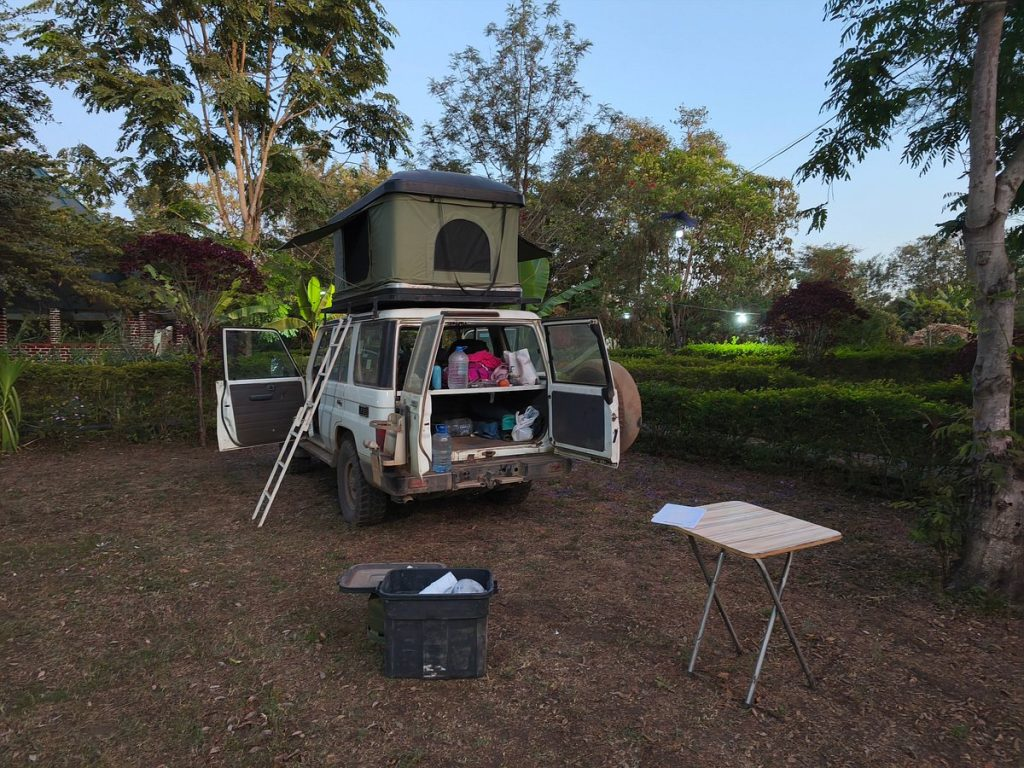
Best Campsites for Rooftop Tent Camping in Uganda
4.1 Murchison Falls National Park
Uganda’s largest park (3,893 km²) stretches across the Albertine Rift Valley and offers the best big-game self-drive in the country. The mighty Nile churns through a 7-metre gorge here — one of Africa’s great spectacles.
Top Campsites
- On the south bank of the Nile, close to the ferry crossing. Hot showers, flush toilets, and a shared cooking shelter. Ideal first night. Fee: approx. USD 30/person/night. Paraa Public Campsite:
- Upscale public camping near the Nile. Shared ablutions are well maintained. Fee: approx. USD 40/person/night. Nile Safari Lodge Bush Camp:
- Popular with overlanders for its reliable hot water and communal braai facilities. USD 20/person/night. Red Chilli Rest House Campsite (Paraa):
- Remote, minimal facilities, excellent for birding and solitude. Bring all water. USD 25/person/night. Wankwar Campsite (North Bank):
Wildlife to Expect at Camp
- Hippos graze the riverbank after dark — do not walk to the river at night
- Baboons are camp regulars; lock vehicle doors when leaving even briefly
- African buffalo have been known to enter Paraa campsite — maintain awareness
- Excellent birding from the rooftop tent at dawn: Shoebill habitat is nearby at Murchison
Queen Elizabeth National Park
Queen Elizabeth is Uganda’s most biologically diverse park — home to tree-climbing lions, forest elephants, chimpanzees, and over 600 bird species. The Kazinga Channel boat cruise is world-class.
Top Campsites
- On the peninsula above the Kazinga Channel. Excellent views, reliable power for fridge charging. Fee: USD 30/person/night. Mweya Public Campsite:
- Southern sector, home of the famous tree-climbing lions. Minimal facilities; carry your own water. USD 25/person/night. Worth every shilling for the authenticity. Ishasha Wilderness Campsite:
- Near Kyambura Gorge and chimpanzee tracking. Shaded sites, communal ablutions. USD 28/person/night. Kyambura Campsite:
Campfire Experience
Evenings at Queen Elizabeth can include elephant silhouettes at the waterhole and choruses of hippos below the escarpment. A rooftop tent at Ishasha, with tree-climbing lions resting overhead in the fig trees, is one of East Africa’s most memorable wildlife experiences.
Bwindi Impenetrable National Park
Bwindi is home to roughly half the world’s mountain gorilla population. The dense montane forest creates a microclimate of mist, rain, and extraordinary beauty. Camping here is atmospheric in the extreme.
Top Campsites
- Adjacent to UWA park headquarters; good security, hot showers, charging points. USD 20/person/night.Buhoma Community Campsite:
- Quiet, well-maintained, close to gorilla tracking registration. USD 25/person/night.Silverback Lodge Campsite:
- Higher altitude (2,350 m), cooler temperatures, exceptional birding. USD 18/person/night.Ruhija Community Camp:
- Southern sector, more remote, spectacular ridge views into DRC. USD 20/person/night.Nkuringo Campsite:
🥶 Cold Nights Note: Bwindi nights can drop to 8°C. Ensure your rooftop tent has a proper sleeping bag rated to at least 5°C and an anti-condensation mat. Altitude sickness is unlikely at 1,160–2,607 m but acclimatise if driving up from Kampala in one day.
Gorilla Tracking & Camp Logistics
- Gorilla permits: USD 700 per person per trek (book months in advance through UWA)
- Return to camp by 14:00–15:00 typically, leaving afternoon for birding or village walks
- Half-day treks possible — leaving the afternoon free to restock supplies in Buhoma village
Kidepo Valley National Park
Uganda’s most remote and arguably most spectacular park. A 10-hour drive from Kampala — or a short flight to Apoka — rewards with savannah, kopjes, roan antelope, cheetah, and a true wilderness experience unmatched in East Africa.
Top Campsites
- At the park headquarters, near a waterhole that attracts elephant and zebra at dawn. Reliable ablutions, hot showers. USD 30/person/night.Apoka Public Campsite:
- Remote bush camp in the north of the park. No facilities — full self-sufficiency required. USD 20/person/night. The ultimate rooftop tent experience. Kakine Wilderness Camp:
Why Kidepo is Perfect for RTT Camping
- No light pollution — among the darkest skies in East Africa, ideal for stargazing from the open rooftop
- Cheetah and painted hunting dog sightings are realistic in the Narus Valley
- Less than 20,000 visitors per year — you may have the park entirely to yourself
- Mobile data: near-zero. Carry a satellite communicator.
Lake Mburo National Park
Lake Mburo is Uganda’s closest national park to Kampala (just 3 hours on tarmac). It is the only park in Uganda where you can walk without a ranger permit, and the only one with zebra and eland.
Top Campsites
- Lakeside setting, hippos in earshot, good ablutions. USD 25/person/night.Rwonyo Public Campsite:
- Elevated bush setting with stunning Acacia views. Well-run. USD 30/person/night.Mihingo Lodge Campsite:
An ideal first park for self-drive camping beginners given its proximity to Kampala, well-graded tracks, and small size (370 km²).
Complete Camping Packing List for Uganda
Shelter & Sleeping
- Rooftop tent (pre-fitted to vehicle)
- Sleeping bags: 5°C rated minimum (highland parks); 15°C liner bag for lowland parks
- Pillow (compressible travel pillow recommended)
- Anti-condensation mat (standard in most quality RTTs)
- Small LED lantern for the tent interior
- Headtorch with red-light mode (red light preserves night vision around wildlife)
Kitchen & Food
- Portable compressor fridge/freezer (50–60 L): loaded with 3–5 days of perishables before remote sections
- 2-burner gas stove + 2× spare gas canisters
- Pots set (1 large, 1 medium, 1 small), frying pan
- Plates, mugs, bowls, cutlery (4 persons)
- Sharp cook’s knife + chopping board
- Washing-up basin, biodegradable soap, sponge
- French press coffee maker (weight-efficient)
- Dry goods: coffee, tea, oats, pasta, rice, lentils, canned beans, canned fish, peanut butter, crackers
- Fresh produce: buy in Kampala before departure and restock in Fort Portal, Kasese, or Kabale
- Drinking water: 40 L minimum (2× 20 L jerry cans) for remote parks
- Water purification tablets as backup
- Collapsible bucket for washing
Personal & Health
- Malaria prophylaxis (consult your doctor 6 weeks before travel)
- DEET-based insect repellent (at least 50% concentration)
- Permethrin clothing spray
- Long-sleeve shirts and trousers for dusk/dawn
- Comprehensive first aid kit: include antidiarrhoeals, antihistamines, rehydration sachets, blister pads, broad-spectrum antibiotic (prescription)
- Personal medications + spare prescription
- Hand sanitiser
- Sunscreen (SPF 50+)
- Eye drops (dust on Kidepo tracks is severe)
- Prescription glasses spare pair if applicable
Clothing by Park Type
Lowland Parks (Murchison, Queen Elizabeth, Lake Mburo)
- Lightweight khaki or olive cotton long trousers × 2
- Short-sleeve shirts × 3 (moisture-wicking)
- Long-sleeve sun shirt × 1
- Fleece jacket for evenings
- Wide-brim sun hat
- Closed-toe walking shoes or trail runners
- Sandals for camp
Highland Parks (Bwindi, Mgahinga, Kidepo elevated areas)
- All of the above, plus:
- Waterproof hiking trousers or rain pants
- Mid-layer insulated jacket
- Waterproof shell jacket (essential for gorilla trekking)
- Gaiters for leech protection in Bwindi
- Warm beanie and light gloves for cold nights
- Waterproof hiking boots (ankle support for gorilla terrain)
Vehicle & Recovery Gear
- Hi-lift jack + base plate
- Traction boards × 2 (MAXTRAX or equivalent)
- Tow strap (at least 8 tonne rating)
- D-shackles × 2
- Portable air compressor / tyre inflator
- Tyre repair kit (plug strips + CO₂ canisters)
- Full-size spare wheel (confirm vehicle has one — some rentals carry a space-saver)
- Wheel brace and vehicle jack
- Jumper cables or jump pack
- Spare engine oil (2 L), coolant (1 L), brake fluid
- Multi-tool + basic toolkit
- Duct tape, cable ties, baling wire
- Fire extinguisher (2 kg dry powder, fitted to roll cage or under seat)
Power & Electronics
- Dual battery system (factory fitted on rental LX units from reputable operators)
- 12 V extension lead (4 m) for fridge placement flexibility
- USB charging hub
- Laptop + hard drive for trip documentation
- Camera + extra batteries (charge via 12 V or inverter)
- Binoculars: 10×42 recommended for Uganda’s big game and birding
- Satellite communicator (Garmin inReach Mini recommended) for Kidepo
- Offline navigation device or phone mount with charger
- Power bank (20,000 mAh minimum)
Camping Safety in Uganda’s National Parks
Wildlife Safety Around Camp
Africa’s bush requires constant situational awareness, but Uganda’s parks are generally safe for experienced campers who follow basic protocols.
At Night
- Never walk unaccompanied after dark — always use a torch and scan for wildlife before leaving the vehicle
- Keep tent zips fully closed at all times — even in warm weather
- Store all food inside the vehicle, not in tent storage bags or under the awning
- Dispose of dish water at least 50 m downwind from the tent
- If wildlife approaches camp, stay quiet and still — do not run
- Keep a whistle and air horn in the tent for emergencies
At Dawn
- Check the ground around the vehicle ladder before descending — snakes shelter in shade
- Scan the immediate area before letting children descend
- Buffalo and hippo can be present in camp in the early morning — wait for visibility
Specific Wildlife by Park
- Murchison Falls: Hippos, crocodiles (river access), buffalo, elephants at camp periphery
- Queen Elizabeth: Hippos, baboons, hyena, occasional lion near Ishasha camp
- Bwindi: Forest elephants, black-and-white colobus (camp raiders for food scraps), few dangerous animals
- Kidepo: Lion, hyena, elephant — Kakine camp requires heightened vigilance
- Lake Mburo: Hippos, zebra, hyena — relatively safe for first-time bush campers
Medical & Health Preparedness
- Malaria is present year-round in all lowland parks — take prescribed prophylaxis without gaps
- Seek shade and hydrate heavily in Queen Elizabeth and Murchison between 11:00 and 15:00
- Yellow Fever vaccination is mandatory for Uganda entry and enforced at borders — carry certificate
- Hepatitis A and Typhoid vaccination recommended
- Nearest hospital to Kidepo: Moroto (3 hours) — carry a comprehensive kit
- AMREF Flying Doctors medical evacuation insurance is strongly recommended for remote itineraries
Vehicle Security
- Lock the vehicle whenever you are away from camp, even briefly
- Engage the steering lock
- Keep passports, cash, and electronics inside the locked vehicle when not in use
- In Kampala, use guarded overnight parking only — never leave a rooftop-fitted vehicle unattended on the street
- Note the vehicle registration and rental company emergency number in your phone and on paper
Suggested Rooftop Tent Camping Itineraries
The 7-Night Classic Uganda Loop
A balanced introduction covering Uganda’s three most accessible parks with rooftop tent nights at iconic sites.
- Kampala → Ziwa Rhino Sanctuary (enroute stop, optional) → Murchison Falls NP. Night at Paraa Campsite.Day 1:
- Full day game drive, North Bank circuit. Afternoon Nile boat cruise to the falls base. Night at Paraa Campsite.Day 2:
- Morning game drive, Buligi sector. Afternoon depart for Queen Elizabeth. Night at Mweya Campsite.Day 3:
- Kazinga Channel boat cruise at dawn. Full game drive in Kasenyi Plains. Night at Mweya Campsite.Day 4:
- Drive to Ishasha sector (tree-climbing lion territory). Afternoon game drive. Night at Ishasha Campsite.Day 5:
- Morning at Ishasha, depart for Lake Mburo via Kabale/Mbarara. Night at Rwonyo Campsite, Lake Mburo.Day 6:
- Morning walking safari in Lake Mburo. Horse-riding optional. Afternoon return to Kampala (3 hrs).Day 7:
The 10-Night Gorilla & Wilderness Loop
For those adding the gorilla experience to a rooftop tent adventure.
- Kampala → Murchison Falls. Two nights at Paraa or Wankwar Campsite.Day 1–2:
- Drive south to Fort Portal. Night at community campsite outside Kibale NP.Day 3:
- Chimpanzee tracking in Kibale. Afternoon drive to Queen Elizabeth. Night at Mweya.Day 4:
- Queen Elizabeth game drives and Kazinga Channel. Two nights Mweya.Day 5–6:
- Drive to Bwindi (Buhoma). Night at Buhoma Community Campsite.Day 7:
- Gorilla trekking (permit required). Evening celebration in camp. Night at Buhoma.Day 8:
- Optional second gorilla trek or birding walk. Drive to Lake Mburo. Night at Rwonyo.Day 9:
- Morning at Lake Mburo. Return to Kampala. Day 10:
The 14-Night Grand Uganda Safari (Including Kidepo)
The full experience — adding Uganda’s most remote wilderness to the classic loop.
- Kampala → Murchison Falls. Three nights exploring the north and south banks.Days 1–3:
- Murchison → Kidepo (long drive via Gulu and Kitgum, or fly). Two nights at Apoka or Kakine.Days 4–5:
- Full day Kidepo game drive — cheetah, roan antelope, painted hunting dog, lion.Day 6:
- Morning Kidepo. Long drive back via Gulu to Murchison or Kampala (fly alternative).Day 7:
- Queen Elizabeth — Mweya and Ishasha.Days 8–9:
- Bwindi — gorilla trekking, birding, community walks.Days 10–12:
- Drive to Lake Mburo via Kabale.Day 13:
- Lake Mburo morning, return to Kampala.Day 14:
Campsite Cuisine: Cooking on the Road
One of the great pleasures of rooftop tent camping is eating well on the road. The Land Cruiser’s rear load bay doubles as a camp kitchen when the fridge, stove, and prep board are arranged efficiently.
Meal Planning for a 7-Day Trip
Pre-plan meals per day to minimise fridge opening and reduce spoilage. Here is a practical approach:
Breakfasts (simple, fast, energy-dense)
- Oats with powdered milk and banana (available en route at any market)
- Scrambled eggs + toast on the gas burner (eggs keep 7–10 days unrefrigerated in Uganda’s highland climate)
- Peanut butter on crackers + fruit + instant coffee
- Fresh mandazi (buy from roadside stalls near Kasese, Fort Portal, or Kabale)
Lunches (eaten on the road or at picnic sites)
- Pre-prepared sandwiches with canned tuna or avocado
- Cold pasta salad with canned chickpeas and olives
- Chapati rolls (buy fresh in towns) with peanut butter and banana
- Instant noodle soup from a flask of boiling water prepared at breakfast
Dinners (the social heart of rooftop tent camping)
- Pasta with tinned tomato, garlic, and canned sardines
- Rice and lentil dhal with fried plantain
- Grilled fish (buy fresh tilapia at Lake Mburo or from Lake Albert near Murchison)
- Beef stew with local sweet potatoes and groundnut sauce (g-nut sauce is available in Kampala and Fort Portal markets)
- Bean and vegetable curry with ugali or rice
Responsible Fire Building in Uganda’s Parks
- Fires permitted only in designated fire rings at official campsites — check UWA regulations per park
- Use only dead wood or carry your own charcoal from Kampala — do not break live branches
- Extinguish completely with water before sleeping — embers smoulder for hours
- Never light a fire under the rooftop tent — even when parked at an angle
- A gas stove is always the safer and more reliable option in Uganda’s parks
Environmental Responsibility & Leave No Trace
Uganda’s national parks are fragile ecosystems dependent on visitor respect for their long-term survival. Rooftop tent campers have a smaller footprint than lodge guests but a more direct impact on the bush.
- Pack out all waste: No rubbish bins exist at remote campsites. Carry compactable rubbish bags and dispose in Kampala or at Mweya.
- Grey water disposal: Never pour grey water near waterholes or streams. Dispose at least 50 m from any water source.
- Biodegradable products only: Soap, shampoo, and dishwashing liquid should be certified biodegradable (Dr. Bronner’s or equivalent).
- Track discipline: Never drive off established tracks — Uganda’s soils compact easily and tyre tracks can remain visible for years.
- Human waste: Use campsite ablution blocks where available. In remote areas, cat-hole method (30 cm deep, 60 m from water sources, fully covered).
- Wildlife interactions: Do not feed wildlife, leave food out, or attempt to attract animals to camp for photography.
- Cultural sensitivity: Many national parks border community land. Ask before photographing local people. Purchase locally made crafts to support community livelihoods.
Park Entry Fees (2026/2027 — non-resident)
- Murchison Falls NP: USD 40/person/day
- Queen Elizabeth NP: USD 40/person/day
- Bwindi Impenetrable NP: USD 40/person/day + USD 700 gorilla permit
- Kidepo Valley NP: USD 40/person/day
- Lake Mburo NP: USD 40/person/day
- Vehicle entry: USD 30–40 per vehicle per day (non-resident)
- Campsite fees: USD 18–40/person/night (UWA public sites)
Best Times to Visit by Park
- Murchison Falls: Dry seasons June–September and December–February. Best game viewing.
- Queen Elizabeth: Year-round but June–August and December–February are driest.
- Bwindi: Year-round gorilla tracking; June–August and December–February for drier trekking conditions.
- Kidepo: December–April (short and long dry season). Best wildlife concentration around Narus Valley waterhole.
- Lake Mburo: Year-round; excellent zebra viewing in the dry seasons.
